The Convergence: A Research Report on AI, Digital Assets & Institutional Finance
Traditional finance, crypto, and AI are converging to reshape the financial system and our relationship with money. Much of recent financial discussions have focused on how finance and crypto work together, and how crypto rails can support AI, yet the larger change will come from the combination of all three pillars. In our view, this great convergence will alter both the infrastructure through which finance operates and the interface through which we use it. Our inaugural Convergence Report covers the financial primitives behind this evolution of finance along with the facts and figures behind traditional finance (TradFi) institutions onboarding to blockchain and AI technology. All claims are meticulously sourced.
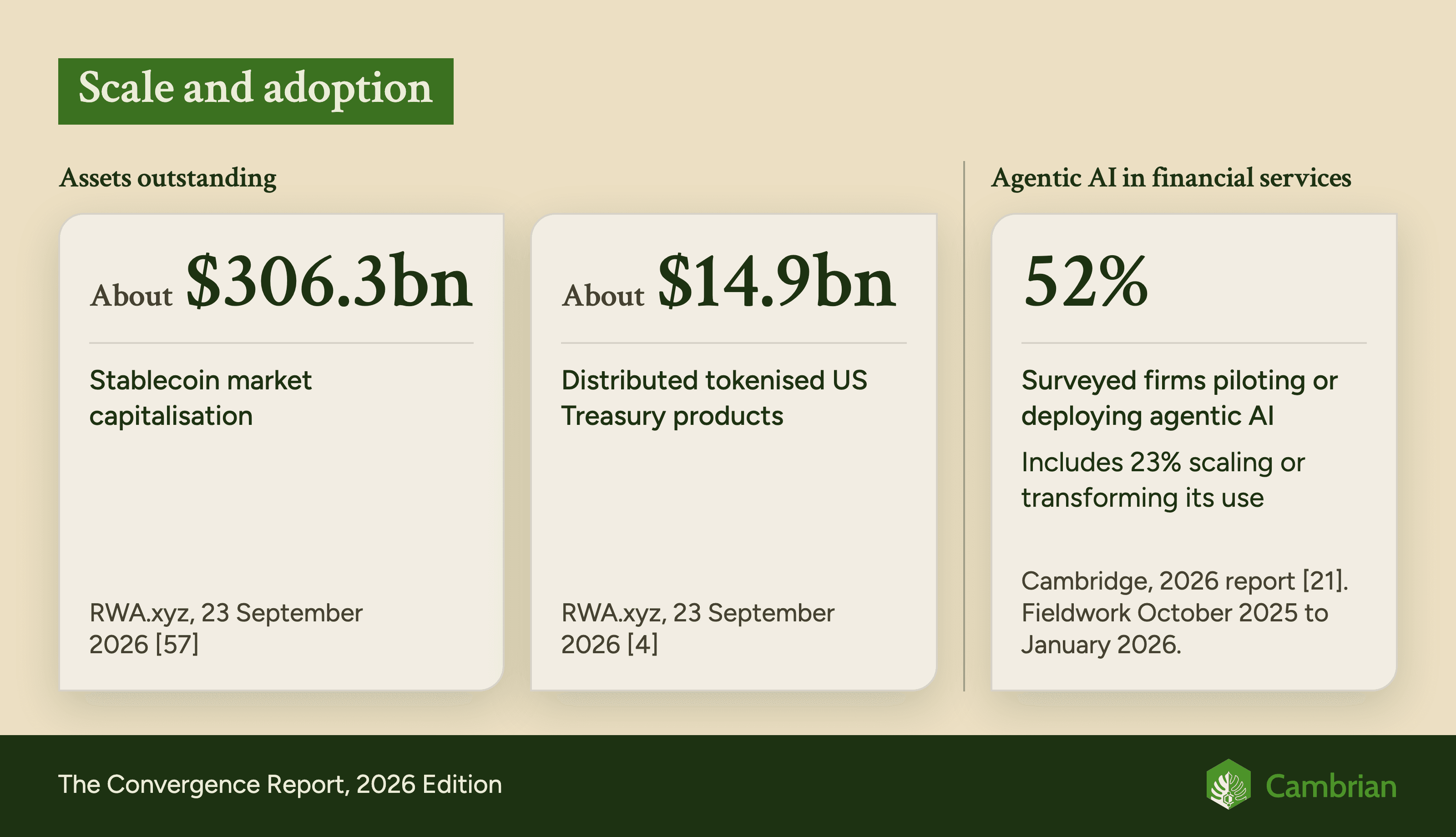
Key figures on the scale of The Convergence.
Introduction to The Great Convergence
The rapid evolution of digital assets in parallel with a Cambrian explosion of performant AI agents has laid the foundation for disrupting global finance. Stablecoins and tokenised assets allow software to transfer funds, settle trades and move collateral under predefined rules, while AI can interpret a user's intent and coordinate those activities across a fragmented financial system. As these capabilities are combined, we expect agents to become our main financial user interface, with people specifying what they want to achieve rather than operating each service themselves.
Programmable assets already represent substantial pools of value: on 23 September 2026, RWA.xyz recorded about $306.3bn of stablecoin market capitalisation and $14.9bn of distributed tokenised US Treasury products [4, 57]. These are measures of outstanding value, with liquidity depending on the market and redemption arrangements.
In addition to adopting digital assets, financial institutions are paying close attention to AI agents. Cambridge’s 2026 Global AI in Financial Services Report found that 52% of surveyed financial services firms were piloting or deploying agentic AI, although only 23% of respondents had reached the more advanced stages of scaling or transforming their use [21]. These findings indicate substantial experimentation and some operational deployment, while full autonomous execution remains rare [22,70].
The first institutional applications of this convergence are likely to bring the three capabilities together inside defined strategies: TradFi supplies the assets, custody, distribution and legal accountability, decentralized finance (DeFi) makes execution programmable and financial state observable, and AI agents can interpret the information and coordinate the actions required. The cases reviewed in this report include live settlement, collateral use and enterprise AI, but they do not yet imply that all three operate together at institutional scale.
Our view at Cambrian is that automation within defined limits offers the more credible near-term path to adoption, because an institution can expand an agent's authority as it demonstrates reliable performance within a defined mandate. The five sections that follow examine how this convergence could develop from individual applications into a financial system in which agents coordinate services across providers. We begin with the infrastructure and evidence of use today, then consider how much authority can be delegated to agents and the data and controls needed to support that delegation. We conclude by examining how this could change the relationship between users and financial providers, and what that means for institutions, builders and allocators.
1. Programmable financial infrastructure
The fundamental action loop for AI agents is the following: an agent observes the relevant state, interprets a goal and decides what to do, then uses permitted tools to act, and checks the result before continuing. Agents could coordinate a user’s finances across providers through software that acts on their behalf. Fintech's ‘unbundling’ shift of the past decade separated financial services into specialised products, while its subsequent rebundling brought them into larger platforms. Forbes’ Azeem Khan connects that development to the convergence of banking, fintech and digital-asset infrastructure [63]. An agent could let the user specify a goal and its constraints, then coordinate the relevant services.
From a human perspective, the change goes from choosing and operating each financial service to supervising the outcome of a process that spans several services. In this scenario, the individual layers of the stack still exist: the bank can still hold the account, the asset manager remains responsible for the fund, and the broker executes the order, and if applicable, a blockchain records the transaction. The agent's role is to translate the user's intent into instructions that each provider is authorised and able to carry out, so control of the interface can change without the underlying institutions disappearing.
What each system contributes to the Convergence
An institution can choose which of these capabilities it needs for a particular process. A permissioned network may provide programmable settlement without relying on public DeFi, while an open lending protocol may provide useful collateral mechanics without replacing the issuer's eligibility checks. Convergence therefore need not produce a singular market architecture. It can preserve existing legal frameworks and apply programmable execution along with AI where these technologies improve the way legal claims are administered, financed or transferred.
The difficulty is making information from these different systems usable within the same decision. A balance needs an owner and an account context, a price needs a source and timestamp, and collateral needs an enforceable claim as well as a market value. An agent must have enough of that context to construct a valid instruction, together with permissions that determine whether it may proceed and a record that allows institutions to inspect the result.
2. Existing points of convergence
How convergence enters financial operations
A bank or asset manager can adopt programmable infrastructure for one part of its operations while retaining its counterparties, legal form, and control obligations. That makes a defined financial process a more plausible starting point for convergence, rather than a wholesale change in market structure, because the institution can measure the benefits and limit the authority handover involved.
Consider a tokenised money market fund used for treasury management. Traditional finance supplies the asset, custody and legal accountability, while the fund interest or its settlement can be represented on a blockchain. In this example, software monitors the cash position, eligibility and yield, while an LLM interprets an instruction or prepares a proposed allocation. Lastly, deterministic controls check that proposal against the treasury mandate before an instruction is signed. This approach to treasury management combines programmable TradFi and AI and could also use an open DeFi market or lending protocol, with the institution retaining control over the combined process. The commercial test is whether that process improves liquidity management, reduces manual work, or makes collateral more usable at comparable cost and control.
Stablecoins and smart contracts can define payment as a step in a software process, thanks to blockchain networks being available around the clock. With protocols like x402, a client requests a resource (e.g., data), receives payment instructions and supplies a signed authorisation over HTTP, with the desired resource returned once settlement is verified. Software can therefore obtain and pay for data or a service as part of its work without a conventional checkout [64]. The x402 Foundation began operating under Linux Foundation governance in July 2026, with members including Visa, Mastercard, Stripe, Google and Coinbase. Their participation brings financial and technology firms into the standard's development. [69].
BlackRock's September 2026 paper, The Machine-Native Economy, argues that frequent, low-value purchases of data and compute are particularly well-suited to blockchain settlement, while agents buying from existing merchants can continue to use conventional payment systems like credit cards [77]. An agent could use both within the same task assigned by a human, with the choice depending on the purchase and the services each provider supports.
A treasury team needs to pay obligations, keep surplus cash invested and make assets available as collateral. The cases below show where software can already carry out parts of that process, providing the operating foundation on which agents can coordinate decisions across providers.
Which components of the convergence stack are live today?
Payment settlement is the first connection. Visa’s reported activity shows stablecoins being used to discharge payment obligations, while x402 gives software a way to pay for a resource within the task it is carrying out. These are different uses of programmable money, with the choice of payment method depending on the transaction and the services available to the payer [6, 64]. The institution still needs to understand its exposure to the issuer and how redemption works when it requires conventional cash.
The regulatory landscape around stablecoins also merits mention, as it varies by jurisdiction. The EU's MiCA stablecoin provisions already apply, while the US is implementing the GENIUS Act [40, 41, 74]. The UK has published final FCA issuance rules for a regime due to expand in October 2027, while the Bank of England intends to finalise its systemic stablecoin Code of Practice by the end of 2026 [42, 75]. An institution must assess the issuer and redemption rights under the rules applicable to the particular product they are developing.
Tokenised Treasury products extend programmable infrastructure to assets that institutions already use for cash management and collateral. On 23 September 2026, tokenised asset analytics platform RWA.xyz recorded about $14.9bn of distributed tokenised US Treasury products, including roughly $2.23bn in BUIDL [4]. Its 'distributed' category covers assets that can move beyond the issuing platform and transfer between wallets, including where those transfers require eligibility checks [62]. BUIDL is, however, not available to everyone. It remains an exempt private offering for qualified purchasers, which is an access model other fintechs and institutions may wish to replicate [7, 58, 60].
BUIDL’s use as collateral demonstrates why representing a fund interest onchain can matter beyond distribution: an investment can support another financial transaction without first being sold [10]. Whitelisted investors can also trade BUIDL against USDC through Securitize’s UniswapX request-for-quote integration, launched in February 2026, while primary USD redemption remains subject to business-day processing [54, 67]. An agent meeting a cash obligation needs to know how much can actually be sold, at what price and when the proceeds will be available, because continuous trading hours alone do not answer those questions.
The legal claim remains a separate part of the investment decision. A non-binding statement from three SEC divisions recently distinguished issuer-sponsored tokens from third-party custodial and synthetic structures, explaining that some third-party tokens may fail to convey the underlying holder’s rights and add exposure to the third party’s bankruptcy [59].
Ondo’s launch of Intelligent Portfolios on 24 September 2026 extends tokenisation to portfolio implementation. The first three portfolios use nondiscretionary strategies developed by BlackRock for Ondo, with Ondo implementing the allocations and scheduled rebalancing through smart contracts [80]. The products give eligible non-US investors tokenised exposure to a portfolio, rather than direct ownership of its underlying funds. This demonstrates institutional portfolio design being implemented onchain through predefined rules, without BlackRock managing the tokens or an AI model making discretionary investment decisions [81].
Institutional networks provide further evidence of production use, although their figures describe activity within the operators' own systems. On 12 August 2026, J.P. Morgan reported that its digital assets platform Kinexys had processed more than $4tn since inception, with average daily value of $7bn [11]. DTCC used tokenised DTC-held assets in production trades involving more than 30 firms, while its broader service remained scheduled for October 2026 [13].
Aave Horizon, Aave’s institutional lending market, shows how institutional controls can coexist with DeFi lending mechanics. Qualified users supply issuer-permissioned real-world assets as collateral and borrow stablecoins through Aave smart contracts, while issuers retain responsibility for allowlisting and KYC [16]. From August 2026, new collateral listings also require governance approval supported by risk and technical assessments [73]. The arrangement makes control over the asset set explicit, but lending still depends on current net asset values, credible prices and liquidation and redemption routes that can realise collateral quickly enough to meet the lending agreement’s obligations. The BIS describes the corresponding oracle trade-off: a centralised source introduces a trusted party, while decentralised alternatives can add complexity and inefficiency [37].
The comparison for an institution is between two ways of achieving the same financial outcome: its existing arrangements and a process using programmable assets. Tokenisation earns a commercial role where it makes collateral easier to deploy, reduces reconciliation or improves access at an acceptable total cost. AI then adds the ability to interpret the institution’s objective and coordinate those functions, which makes the authority granted to the agent the next question.
3. Delegating financial authority
Authority defines what an agent is permitted to do, while autonomy describes how independently it selects and carries out its actions. An agent can monitor several accounts and prepare a proposed allocation without permission to transact, while a narrowly defined transfer can execute automatically under fixed rules. The distinction matters because evidence that a firm uses AI does not tell us which financial decisions it has delegated.
Cambridge’s industry sample comprised 352 financial-services organisations, including 203 fintechs and 149 traditional financial institutions, with fieldwork running from October 2025 to January 2026. The reported 52% of financial organizations includes 29% piloting agentic AI and 23% scaling or transforming its use [21]. The evidence on granting autonomy is narrower: the FSB’s June 2026 consultation report found little evidence of generative AI being used for fully autonomous trading, while the Bank of England’s July assessment placed most use of autonomous AI in the fields of financial research, coding support, surveillance and lower-risk operations [22,70].
Institutions can gain useful capability before delegating execution. In its 2025 annual letter, published in April 2026, JPMorganChase reported that its transaction-screening system reviewed more than twice the previous volume while halving manual checks [25]. The company did not disclose the underlying baselines, which limits comparison with results at other institutions. This concerns the coverage and efficiency of an existing process, leaving a separate decision about the responsibility given to software once it has produced its analysis.
For individuals and smaller institutions, access to continuous research, scenario analysis and portfolio monitoring could bring capabilities that previously required a much larger team. Widely available models will also make those capabilities easier for competitors to reproduce. Our assessment is that durable advantage is more likely to depend on better data, context specific to the user and the quality of their decisions and execution than on access to a general model alone.
A financial agent's authority can be assessed at three levels:
- Inform and recommend: retrieve approved information, explain it and propose an action without changing financial state.
- Prepare: construct an instruction for a defined operation and check it against company policy, with the signing decision kept separate.
- Execute within limits: sign under an explicit mandate, with activity monitored and authority that can be revoked.
An agent's coordination scope is separate from its execution authority. It could become the user's main financial interface by preparing instructions across providers, while each transaction still requires human approval.
Robinhood's agentic trading product shows why execution and data permissions should be assessed separately. In Robinhood’s new agent-powered offering, trades are confined to a dedicated Agentic account and access can be revoked. The agent can read balances, positions and transaction history across the user's Robinhood accounts [65, 68]. Its current rules allow eligible crypto trades in the Agentic account but reserve transfers, staking and lending for the user [68]. Similarly, Stripe's Shared Payment Tokens allow an agent to initiate a transaction without seeing the underlying credential, while restricting the business, time and amount of the payment and allowing the token to be revoked [66]. These company-reported designs illustrate limits on authority without establishing adoption at scale.
Cambrian’s Agentic Finance Landscape separates the intelligence used to make a decision from the degree of autonomy in carrying it out. In its project-reported sample, the largest pools of managed capital remained associated with rule-based allocation [1]. That finding describes how the reported capital is managed, rather than investors’ willingness to delegate, and supports assessing model-led judgment separately from automated execution.
Broader autonomy would require an institution to resolve responsibility for the credential, the asset and any loss caused by a misread instruction. It would also need to establish what recovery is available after execution and how much a public transaction record exposes about the user's position or strategy. The institutional cases reviewed here do not yet show that these questions have been resolved for open-ended financial autonomy.
4. Data and institutional control
Agents inherit the financial system's data problems
A financial agent needs a current picture of a user's positions and associated liabilities, including aggregate exposure across venues, liquidity depth, yields and liquidation thresholds. It also needs to account for market events, protocol or counterparty risk and the user's restrictions, because the correct price alone cannot establish whether an action is appropriate. A quoted price may not be available for the intended order size, while collateral may have a market value but remain ineligible to pledge or unavailable to sell or redeem when required.
TradFi holds much of this context across banks, brokers, custodians, administrators and internal systems, where records can remain siloed and require manual reconciliation. DeFi makes more state publicly observable and readable by software, but a transaction history alone does not establish the beneficial owner, the enforceability of a claim or the quality of an external price. Where a financial process spans blockchains and offchain systems, the agent must reconcile records of the same asset, claim and settlement event, so that an incomplete transfer or duplicate representation is not counted as usable collateral. For the agent to coordinate the user's overall financial position, it would need access to this reconciled data and permissions spanning the relevant providers. Otherwise, it may only improve an individual institution's operations while leaving the user to still manually coordinate between services.
When these records determine whether an action proceeds, an agent can act on stale or invented inputs before anyone has reviewed them. An incorrect balance may produce an allocation the user cannot fund, while an outdated collateral value may permit borrowing beyond the intended limit. Data errors therefore need to be caught before execution, particularly where a settled transaction cannot be reversed.
Visa's September 2026 account of its work with Credit Coop gives a practical example: with customer authorisation, Visa settlement data and onchain records can inform credit assessment and programmable funding, collateral and repayment [6]. The described process does not establish an AI deployment, but it shows how institutional data can determine a financial action on programmable infrastructure. Once information has that role, an incorrect input can create direct financial exposure, making its source and transformation part of the control environment.
From data to an authorised action
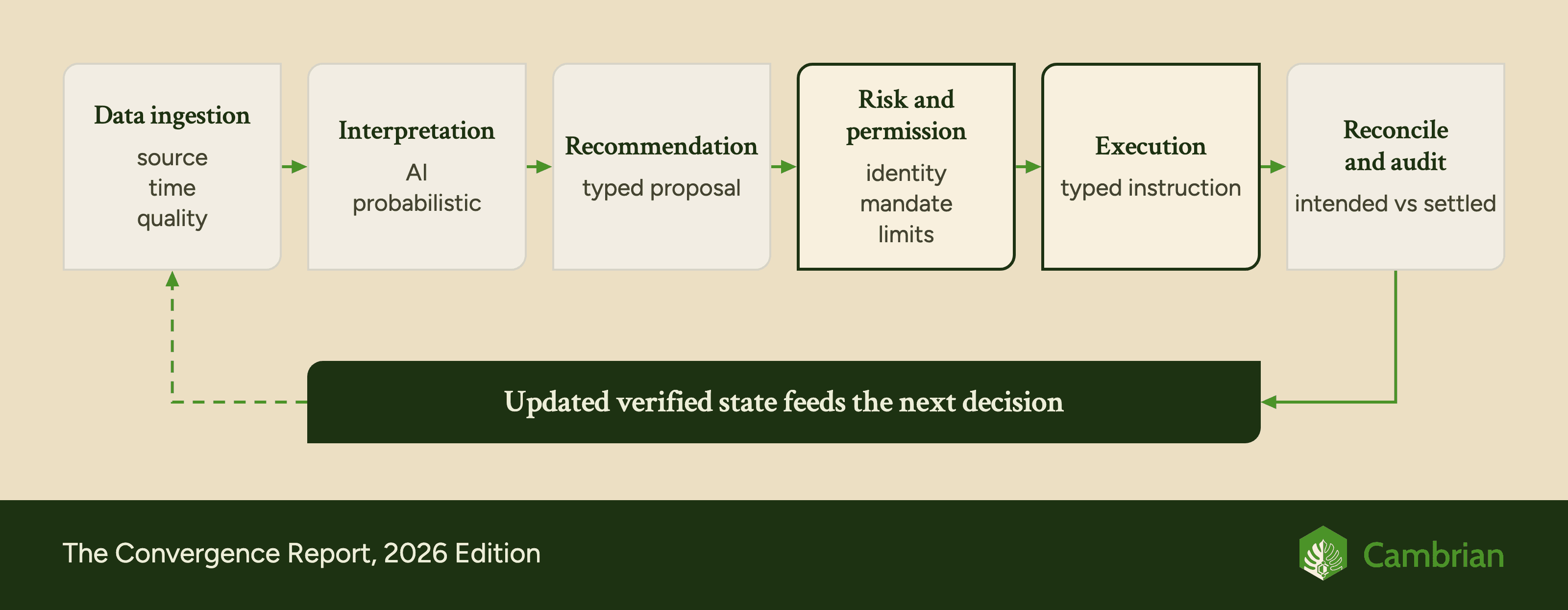
Figure 1. An illustrative controlled financial process
The figure illustrates a design in which the agent’s proposal passes through separate checks before it can affect the user’s assets. Market and account data retain their source and timestamp, with freshness assessed against the proposed decision. The recommendation is recorded with its model version and supporting information, then checked against the mandate. Any required approval is obtained before signing, and reconciliation establishes whether the settled result matches the instruction. Authority can be withdrawn to stop future activity, although this does not necessarily reverse a transaction that has already settled.
The quality of this information also affects the decisions the agent can make. In his August 2026 CFA Institute paper, Joseph Simonian argues that cheaper analysis of public information does not eliminate advantages from proprietary data, specialist execution and institutional knowledge [82]. Our view is that the commercial opportunity lies in converting information into a usable understanding of the user’s position: which assets are available, what obligations they support and which opportunities remain actionable after costs. In onchain markets, public records still require interpretation and reconciliation before they can provide that view. Proprietary information can strengthen the analysis, but exclusivity alone says little about its relevance or reliability.
5. Institutional adoption and operating implications
The most plausible early applications have a defined financial task whose result can be measured, such as cash management, settlement or collateral use. Reconciliation and reporting can improve before execution is delegated, allowing institutions to test where an agent adds value and where established rules already work.
AI may also create financial demand through the resources it consumes. An agent could compare models, buy data and pay for compute within an approved budget [77]. Stripe’s August 2026 agreement to acquire OpenRouter, which routes requests across model providers, reflects the link between payment infrastructure and model selection [78]. BlackRock extends the argument to tokenised claims on compute capacity that could be transferred, financed or used as collateral. Their usefulness depends on an enforceable claim to a specified service and the supplier’s ability to deliver it, while differences in hardware and service terms complicate comparison and liquidity remains limited [77].
Implications for institutions, builders and allocators
Institutions face a choice about how much of the coordinating role they want to provide. Making products usable by agents may preserve distribution, while understanding the customer’s position across providers creates an opportunity to influence which services are selected. That decision affects which capabilities to build internally and where partnerships make more sense.
For builders, more capable and widely available models increase the importance of information and expertise specific to a financial task. A service can differentiate through the quality of its data and its ability to turn fragmented records into a reliable view of the user’s position. Knowing what a user owns has limited value without the account restrictions and liquidity information needed to determine what they can actually do with it.
Allocators should assess an agent’s information and assumptions alongside the assets it selects. Shared dependencies may cause different portfolios to respond similarly under stress [47]. A simpler interface leaves the underlying claim and redemption terms unchanged. The value of delegation depends on whether it improves decisions and execution within the investor’s constraints.
A new future for finance
Our view is that convergence will shift a greater share of financial coordination towards agents, giving the providers trusted to act on a user’s behalf more influence over product selection and the customer relationship. Banks, asset managers and custodians would still perform essential functions, while competing to have their services selected through that interface.
The commercial opportunity extends across asset classes. As capable models become more widely available, we expect durable advantage to depend increasingly on financial information that is difficult to reproduce and useful in a specific decision. Combining that information with reliable execution within agreed permissions gives users a reason to delegate more of their financial activity to the provider. For institutions, the strategic choice is whether to compete for that coordinating role or concentrate on supplying the products it selects.
Follow the author, Jason Brannigan on X at @Ja_Brann for more news on The Convergence.
About Cambrian
Cambrian is the financial intelligence layer for agents and institutions. Our API delivers real-time and historical blockchain data, covering yield, liquidity positions, risk, trading activity, and market sentiment, for agentic and institutional DeFi applications. Founded in 2024, Cambrian is backed by Polychain Capital, Franklin Templeton, a16z crypto, Flow Traders, Selini Capital, and others.
This content is for general information only and does not constitute financial, investment, legal, or tax advice. Accuracy is believed reliable at the time of publication but is not guaranteed, and opinions may change without notice. You should conduct your own research and consult qualified professionals before making decisions. References to third‑party projects do not imply endorsement. The author and publisher accept no liability for any loss or damage arising from reliance on this material.
Selected sources
Citation numbers follow the master research index. Only sources used in this working draft are reproduced below.
[1] Cambrian, “Agentic Finance Landscape Q2 2026”, 2 June 2026.
[4] RWA.xyz, Tokenized U.S. Treasuries, data displayed and reviewed 23 September 2026.
[6] Visa, Visa Brings Onchain Lending into Everyday Payments, 8 September 2026.
[11] J.P. Morgan, Kinexys activity figures reported in its Future of Finance Awards announcement, 12 August 2026.
[13] DTCC, DTCC Turns Tokenization into Reality with First-Ever Production Trades, 15 July 2026.
[16] Aave, Aave Horizon Launches, 26 August 2025, reviewed 13 September 2026.
[22] Financial Stability Board, Sound Practices for Responsible Adoption of Artificial Intelligence (AI): Consultation report, 10 June 2026.
[25] JPMorganChase, “2025 Corporate & Investment Bank annual letter”, 6 April 2026.
[37] Bank for International Settlements, “The oracle problem and the future of DeFi”, 7 September 2023.
[41] European Securities and Markets Authority, MiCA: entry into force and application, reviewed 13 September 2026.
[42] Bank of England, Policy statement and draft rules on regulating systemic stablecoins, 22 June 2026.
[57] RWA.xyz, Stablecoins, data displayed and reviewed 23 September 2026.
[58] US Securities and Exchange Commission, BlackRock USD Institutional Digital Liquidity Fund Ltd.: Form D amendment, 17 July 2025.
[60] Securitize, BlackRock USD Institutional Digital Liquidity Fund: primary-market offering, reviewed 13 September 2026.
[62] RWA.xyz, “A New Framework for Tokenized Assets: Distributed & Represented”, 21 November 2025.
[63] Azeem Khan, “The Rebundling of Finance Is Really a Story About Digital Assets”, 23 June 2026.
[64] Coinbase, “Introducing x402: a new standard for internet-native payments”, 6 May 2025.
[65] Robinhood, “Robinhood is Now Open to Agents”, 27 May 2026.
[66] Stripe, “Introducing our agentic commerce solutions”, 7 October 2025.
[67] Uniswap Labs, Uniswap Labs and Securitize Partner to Unlock DeFi Liquidity for BlackRock's BUIDL, 11 February 2026.
[68] Robinhood, Agentic Trading overview, reviewed 23 September 2026.
[69] Linux Foundation, Operational launch of the x402 Foundation to standardise internet-native payments for AI agents and applications, 14 July 2026.
[70] Bank of England, Financial Stability Report: July 2026, section 3.5 on AI in financial markets, reviewed 13 September 2026.
[73] Aave Labs, Update on Aave Horizon Asset Onboarding Process, 14 August 2026.
[74] Office of the Comptroller of the Currency, Statement on the GENIUS Act implementing-rule timetable, 19 August 2026.
[75] Financial Conduct Authority, Cryptoasset regime: policy statements and final rules, 30 June 2026, reviewed 13 September 2026.
[77] BlackRock, The Machine-Native Economy, September 2026, pp. 5–9.
[80] Ondo Finance, Introducing Ondo Intelligent Portfolios, 24 September 2026.